
By Janey Fugate
About 500 million years ago, shallow seas teeming with marine life covered what today are Rockbridge and Botetourt counties. Since then, the Allegheny and Blue Ridge Mountains have risen and a temperate forest environment has evolved where once an ocean existed.
After the seas receded, subterranean streams eroded caves, eventually leaving behind the rock arch called the Natural Bridge.
Despite its staggering age, the bridge and the people around it are now in one of the most important phases of its history. It has recently come under intense scrutiny by multiple organizations concerned about the future of its ecosystem, and the bridge itself is destined become the centerpiece of a new state park.
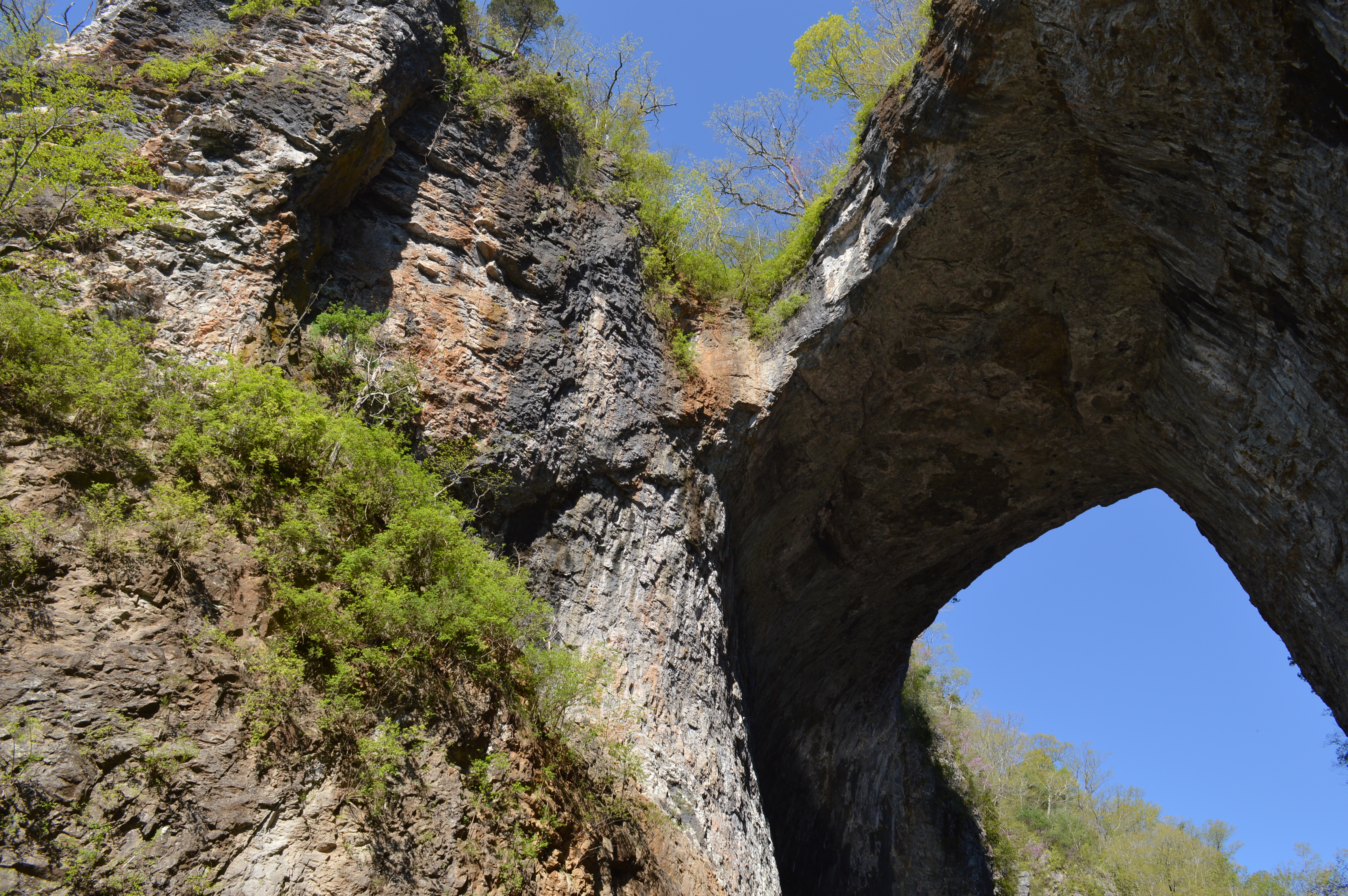
The area around Natural Bridge supports a unique ecosystem that needs protecting, local researchers say.
When the bridge and surrounding 1500 acres of went up for sale last October, conservation groups were worried about development harmful to the local environment. But the Virginia Conservation Legacy Fund’s purchase of the property for $9 million has since relieved those concerns. VCLF, a Roanoke-based nonprofit, says its mission is to turn the property over to the state park system once the purchase loan is paid back.
VCLF project manager and wildlife biologist Jeff Waldon says that despite the property’s commercial value, ensuring that the land’s natural resources remain intact was always a major concern for VCLF and an important factor in the purchase.
“VCLF has a three-part mission of conservation, education and recreation … and in that order, as well,” said Waldon. “So conservation is the highest priority.”
Chris Wise, of the Friends of the Natural Bridge, a group formed to advocate for public ownership of the property, says that conservation groups hope the land’s ecology will be better protected under new management.
“Not only is it going to become a state park, but the people who made the purchase are very environmentally minded,” said Wise.
Though the bridge itself is the most promoted feature of the Rockbridge area, the land’s ecological rarities are what make it environmentally significant, attracting even the National Park Service’s attention when Natural Bridge went on the market last year.
In September 2013, the Park Service analyzed whether the land would meet national park criteria and identified threats to the area’s unique natural resources. The park service report found the land’s ecology significant enough to merit more thorough conservation.
“The rarity of the resources found at Natural Bridge, along with its educational potential, do not appear to be adequately represented by the National Park Service or protected and interpreted by other public or private entities,” the study concluded. That was before VCLF bought the property and pledged to protect it.
One threat to the ecosystem cited in the park service report is water quality. Cedar Creek, a tributary of the James River that formed the bridge and still flows through it, is classified as “impaired.” The creek contains harmful amounts of sediment and chemical pollutants, mainly from agricultural land use happening upstream.
Another symbol of environmental degradation is the highway – U.S. Route 11 – that runs over the bridge. The road and its traffic could “pose threats to the integrity of the geologic formation,” according to the park service report.
Tom Clarke, VCLF’s chief executive, says he is already exploring the possibility of rerouting the highway, along with conservation groups like the Rockbridge Area Conservation Council.
“If [the highway] has the possibility of hurting [the bridge], then it really detracts from that natural experience and we should look at rerouting it,” said Clarke. “And that’s a lengthy and expensive process, but that’s our opinion.”
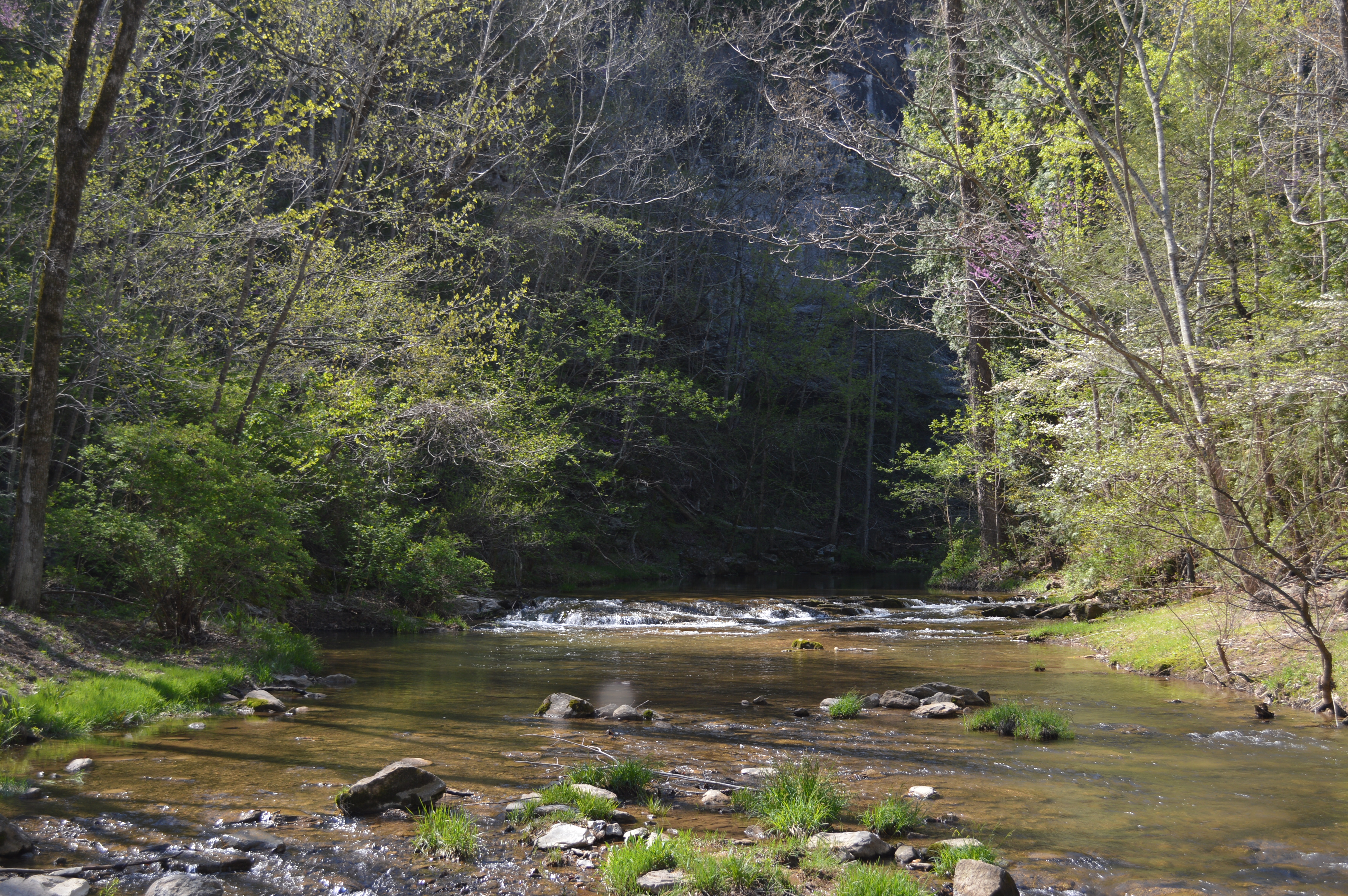
Cedar Creek flows under Natural Bridge before emptying into the James River. Recent tests show the creek has high levels of chemical contaminants.
Despite threats such as water pollution and the highway, the Rockbridge area, including Natural Bridge, is classified as a highly resilient landscape by the Nature Conservancy, an international conservation nonprofit. The organization conducted a study of the Northeast, including Virginia, in which researchers identified natural areas that will be particularly resilient to the projected effects of climate change.
Resilient areas are expected to become vital to certain species’ survival as changing temperatures and human development force migration and re-distribution across landscapes. The level of connectivity between natural spaces in these resilient areas and biodiversity become vital to species’ survival.
“If [Natural Bridge] is removed or damaged or otherwise modified, then it would greatly diminish the resiliency of the surrounding landscape,” said Waldon.
RACC and of the Friends of the Natural Bridge cite species migration as a critical reason for the land’s need to come under state park management. The Cedar Creek Gorge sits in one of the narrowest gaps between the Allegheny and Blue Ridge mountains, creating a “micro-corridor” for animals to travel back and forth between the two ridge systems.
Tom Smith, director of the Virginia Natural Heritage Program, says the movement of species promotes genetic biodiversity, a key aspect of healthy ecosystems.
“It’s important with changes like climate change and species movement and distribution to have these key corridor areas for animals, but then also for plant species,” said Smith.
Wes Teets, a naturalist and ornithologist who works at Natural Bridge, says the corridor’s value is apparent in the property’s wildlife populations.
“Migratory birds that come through here, they’ll use the gorge, Cedar Creek and surrounding hillsides to travel between the Blue Ridge and the Alleghenies,” said Teets. “That’s why we’ve got a lot really good bird species here.”
Black bears are another species that use the corridor to move back and forth.
“I’ve seen more bears than deer on the property,” said Teets.
Smith says there is not a fully protected wildlife corridor between the Blue Ridge and the Alleghenies.
“Even if Natural Bridge became a state park, the corridor wouldn’t be fully protected – it would be a piece of the corridor,” he said.
But even that small piece of the corridor is home to several key natural communities, identified and documented by the Natural Heritage Program, an arm of the Virginia Department of Conservation and Recreation. The program is charged with protecting the state’s biological diversity through identifying rare plant and animal species.
According to Smith, since 1986 the organization has found 30 species new to science in Virginia and 300 species that had never been reported in the state before.
At Natural Bridge, Smith’s team has documented three significant natural communities. A natural community is a group of plant and animal species coexisting in a particular environment. There are two forest communities, or clusters of common tree species that characterize the community, on the Natural Bridge property.
Smith says these particular communities “were once much more common and widespread in the Shenandoah Valley, but with the disturbance from farming that happened … there are very few of those sites left.”
The karst cave system, a network of limestone caves and sinkholes, is another ecological feature of Natural Bridge. There are 11 caves on the property with more than 7,000 feet of surveyed underground passages. The caverns are home to nine documented subterranean species including bats, wood rats, cave salamanders, rare isopods, or crustaceans, and the Natural Bridge cave beetle – found nowhere else in the world.
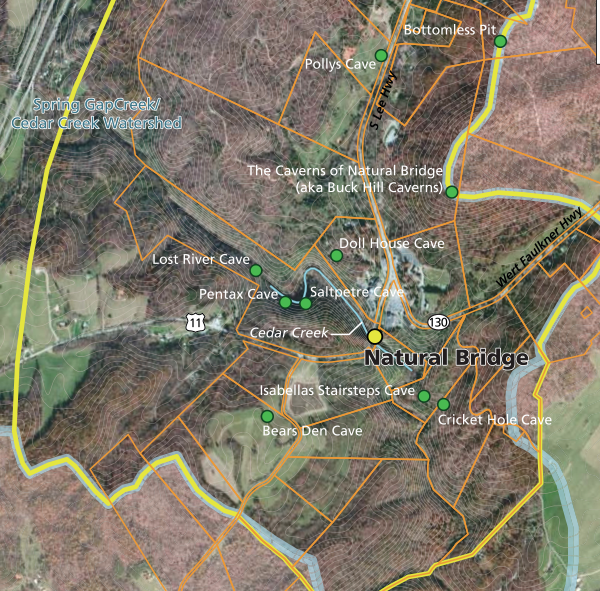
Green dots show the locations of 10 of Natural Bridge’s limestone caves. Click on map to enlarge. Courtesy of the National Park Service
Smith says that under park management the caves’ underground waterways will be assessed to prevent contamination caused by pesticide and petroleum runoff from entering the caves.
The hydrology, biology and geology of Natural Bridge are intertwined, making protection and awareness all the more necessary. Clark and the state are committed to preserving the bridge’s ecosystem as it changes to public ownership.
“We need to talk about nature,” said Clarke. “We need to show how streams work. We need to show nitrates and phosphates coming off from agricultural fields and how they have an effect on fish and marine life.”