
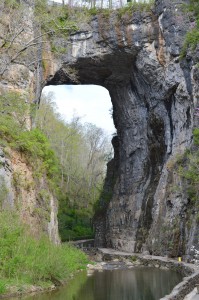
Natural Bridge and more than 1,500 surrounding acres were purchased by Kissito Healthcare CEO Tom Clarke in February. Clarke paid $9.1 million for the property, valued at more than $25 million.
by Andy Soergel
A phone call in the spring of 2013 threw Rockbridge County Administrator Spencer Suter into a 12-month whirlwind.
Jim Woltz, a real estate broker working with longtime Natural Bridge owner Angelo Puglisi, was on the other end of the line.
“Jim called and said, ‘Hey, just a heads up,’” Suter said. “‘Natural Bridge, even though it’s been for sale for years and years, is potentially going on the auction block.’”
“Obviously,” Suter said, “that’s a pretty big shock to a locality. That’s the namesake of the county.”
Suter was familiar with Puglisi, the 88-year-old real estate developer who since 1988 had maintained control of Natural Bridge, the nearby hotel, a series of caverns and a number of other attractions on more than 1,500 acres at the southern end of Rockbridge County.
And Suter was familiar with Puglisi’s desire to sell the iconic bridge and surrounding property, valued at more than $25 million. Puglisi had put it on the market in 2007 for $39 million, but in the depths of the economic recession, suitable local buyers were scarce.
Suter feared that the situation hadn’t changed much by 2013.
“The concern was that someone overseas could come in, shut it down, and close it to public viewing,” he said.
Suter saw an opportunity to turn the bridge over to Virginia residents, but two problems loomed over all others: Money and time. Neither the state of Virginia nor Rockbridge County had the resources to buy the bridge directly from Puglisi, said Suter. He thought the National Park System could potentially help with funding, but he said the time and resource investments involved with national park designation made that route unrealistic.
“There’s a lot more red tape involved with national parks,” he said. “The issue there became time.”
Viewing the bridge had never been cheap. By 2013, an adult admission to see the ancient landmark had reached $21. But Suter feared new private ownership from overseas might take even that away.
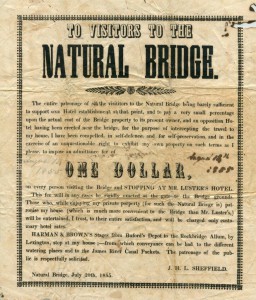
Admission to Natural Bridge in 1855 was $1, about equivalent in today’s dollars to the $21 charged in 2013. New owner Tom Clarke has lowered the price some.
“We have been very fortunate to have a long list of private owners who have allowed [public access],” he said. “But in this day and age, it’s not outside the realm of reason that someone from [another country] comes in and says, ‘I want a piece of Americana to myself, and I want to live right down there under the bridge in a summer house.’”
The bridge’s private ownership can be traced back to King George II, whose grandson, King George III, sold the bridge to Thomas Jefferson in 1774 for 20 shillings. With inflation, that’s about $150 today.
“In many respects, Jefferson acquiring the bridge from the King of England really represents one of the earliest natural destinations in our country,” said Virginia State Parks Director Joe Elton, who is now helping guide Natural Bridge into the hands of Virginia’s state parks system.
“And, for me, I think it’s just remarkable,” Elton said. “Centuries later, people still see the values of that place.”
Suter recognizes the historic, environmental and economic value of Natural Bridge. But he said he was surprised when he heard Kissito Healthcare’s President and CEO Tom Clarke was interested in the property.
Kissito is a healthcare firm based in Roanoke that specializes in nursing homes and assisted living operations. The company organizes a number of overseas volunteer efforts, but Suter said he was puzzled that Natural Bridge was on the company’s radar.
“I started scratching my head a little bit,” he said. “I thought, ‘Are we talking about a nursing home? Because that is not the site for a nursing home.’
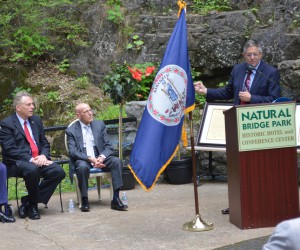
Gov. Terry McAuliffe, seated at left, looks on as Tom Clarke recognizes former owner Angelo Puglisi, seated center, for sharply reducing the sale price of Natural Bridge.
“But that wasn’t it at all,” Suter said. “Mr. Clarke has demonstrated time and time again that he wants to see Thomas Jefferson’s vision stay intact. Mr. Puglisi wanted the same thing, so the issue was how to make that happen.”
The end result was a multi-party deal that Elton described as “the most complicated land transaction” he had seen in his 20 years as Virginia’s state parks director.
Suter helped coordinate a number of parties, including Puglisi, Elton, Clark, Chris Wise from the Rockbridge Area Conservation Council, and Faye Cooper at the Valley Conservation Council, among others. The parties agreed that Natural Bridge should become a state park, and they constructed a deal that Suter said makes the most sense for the state, the private owners, and the bridge.
“There were so many people involved with this process,” he said. “I commend everybody. If one wheel had come off somewhere, it all could have gone awry.”
The deal, signed on Feb. 6, breaks down like this: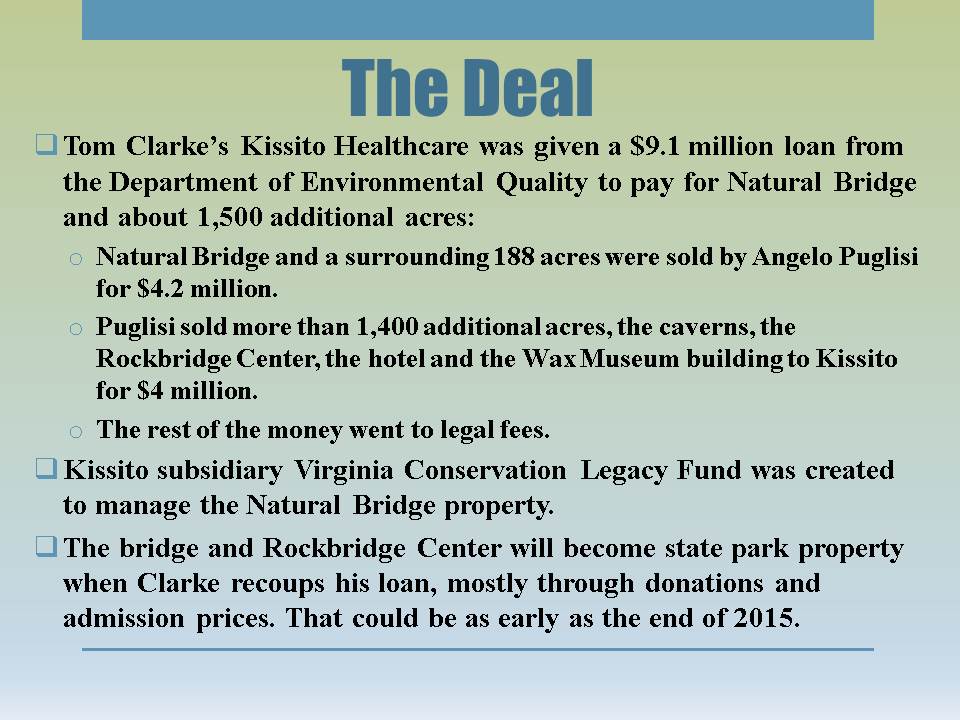
Kissito took out a $9.1 million loan. Of that, $4.2 million in cash was paid to Puglisi for the bridge and the surrounding 188 acres, including the hotel, caverns and wax museum building. Another $4 million went toward the purchase of almost 1,500 additional acres. The rest of the money went to legal fees.
“It was a bargain sale, because the bridge was valued at $25,280,000,” said Clarke. “[Puglisi] made an unbelievably generous donation to us.”
Clarke said the purchase was made possible through low-interest loans offered by the Department of Environmental Quality. Clarke said the state would not have been able to buy the land directly without going through the General Assembly, but the loan money involved had already been appropriated to the DEQ.
A private buyer like Clarke meant less red tape for Natural Bridge supporters, and a loan from the DEQ ensures that the bridge ends up with the state, even if Clarke was to default on the loan.
The deal was structured so that the bridge and about 1,400 acres would become a state park when the loans are paid off. Kissito formed a subsidiary called the Virginia Conservation Legacy Fund to manage Natural Bridge during its transition to the state park system. The fund will maintain ownership of the hotel, caverns and wax museum building after the rest of the property is passed to the Commonwealth.
Puglisi also qualified for Virginia Land Preservation tax credits because of the disparity between the property’s market value and the sale price. Clarke estimates that Puglisi will receive about $16 million total once he receives his tax credits.
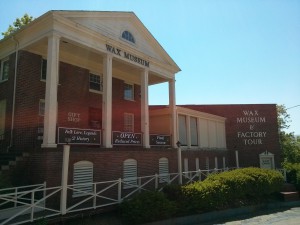
The Wax Museum and Factory Tours attraction will close on Sept. 8. A Virginia history museum could replace the wax figures, said owner Tom Clarke.
The Wax Museum and Factory Tours attraction will close on Sept. 8, Clarke said. The life-size wax figurines will be replaced by what Clarke describes as a Virginia heritage museum, complete with historical artifacts from all over the Commonwealth.
Clarke said an archeological dig will begin this summer on the Natural Bridge property. He said he hopes he will be able to recover additional artifacts to put on display in the museum.
“We have literally had thousands of offers for donations of historical items. And there’s so much local history here,” he said. “I don’t think the Commonwealth can even display 5 percent of what they have.”
The state park system’s budget consistently falls below 1 percent of the Commonwealth’s operating budget. So Clarke says he can put more money into improving Natural Bridge more quickly as a private investor than the Commonwealth’s budget would allow.
“There’s things that the private sector can do that the public sector would have to go to the General Assembly, and that process could take years,” said Clarke. “When you have things like education and basic services that are at risk, it’s hard to say [to the General Assembly], ‘We need more money for state parks.’”
Clarke needs to pay off the $9.1 million in loans before he can realize his goal of turning Natural Bridge over to the state park system. He hopes to be able to do that by the end of 2015. Meanwhile, he is investing in improvements to the property, including a $2.8 million renovation of the 162-room hotel, built in 1963.
“They are … moving at warp speed, faster than anyone might have expected,” said Elton. “And they’re doing nice work. Today, if you walk into the hotel, it has a different feel to it. It feels like the people who work there really care about it and are thinking about the future.”
Clarke said his interest in Natural Bridge is a natural extension of his interest in healthcare.
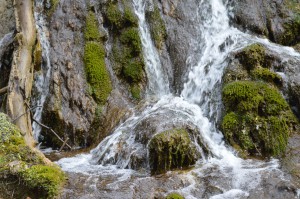
A healthy natural environment around Natural Bridge will benefit all Virginians, new owner Tom Clarke says. The CEO of Kissito Healthcare for more than 20 years, Clarke believes health is defined by more than just trips to the doctor’s office.
“If you go back far enough, health was nutrition — what you ate. Health was activity — what you did for physical exercise. And health was your environment. Health wasn’t CAT scans and MRI’s,” he said. “We see that it was a natural integration of our group’s mission. This is a lot more than just a physical, geological structure.”
Suter, Clarke, Elton and others still have work to do before Natural Bridge is designated a state park. But Suter says he believes Clarke is on the right track to preserving Thomas Jefferson’s legacy.
“From the time I received a phone call last year [from Woltz] to now, at that time, I could not have envisioned a better outcome than we have now,” he said. “I have a tremendous amount of confidence that the state park system will be able to manage this really well.
“Natural Bridge has always been an anchor at the southern end of the county, and this can only help that.”