
By Janey Fugate
For many people, climate change is more a political debate than a threat to survival, confined to remote international conferences, agency reports, White House pronouncements and posturing by Congress.
But the issue is becoming more real to Rockbridge County residents. The area’s ecosystem, and even Natural Bridge, are at risk as the climate changes faster than species can adapt.
The Nature Conservancy, an international conservation nonprofit, conducted an extensive analysis in 2012 that assessed how resilient different landscapes were to the projected effects of climate change. Assessing most of the Northeastern United States, the study classified Rockbridge and Botetourt counties as highly resilient. The analysis eventually encompassed the entire Eastern seaboard.
Resiliency is determined by several measures, two of which are connectivity and landscape diversity. Connectivity is defined as the ability of species to move freely between natural habitats. Landscape diversity is the variation in environment and topography that supports species diversity. Of all the surveyed “ecoregions” in the Nature Conservancy’s Northeast analysis, the Central Appalachian region, which includes the Rockbridge area, “supports the highest diversity of species.”
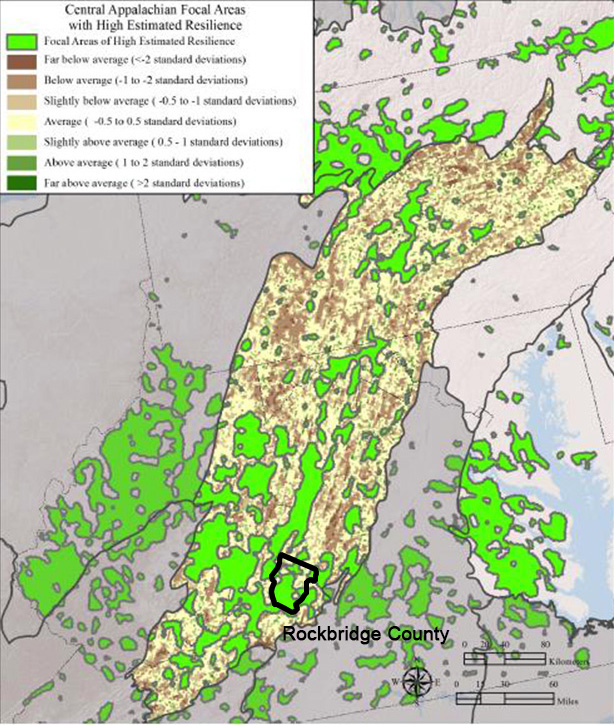
An analysis by the Nature Conservancy found Natural Bridge among the areas in the Central Appalachians that are considered relatively resilient to climate change. Areas in green show regions of high relative resiliency. Click on map to enlarge. Map courtesy of The Nature Conservancy.
The analysis uses these data to advocate for more robust conservation in the area. On a scale from “far below average,” Rockbridge and Botetourt counties were classified as “far above average” in resiliency, the highest classification.
Resilient landscapes are those likely to sustain biodiversity and a vibrant ecosystem despite climate change. But scientists who study the area say urban or agricultural development, pollution and land mismanagement could cause even a resilient ecosystem like Natural Bridge to become more vulnerable.
“If [Natural Bridge] is removed or damaged or otherwise modified, then it would greatly diminish the resiliency of the surrounding landscape,” said Jeff Waldon, wildlife biologist and project manager at Natural Bridge.
The 1500-acre Natural Bridge property, soon to become a state park, is located in a narrow gap between the Allegheny and Blue Ridge Mountains, creating what biologists call a wildlife corridor that allows species to move back and forth between the two ridge systems. Waldon says that makes protecting the area critical.
Climate change caused by fossil fuel emission, evidenced by global temperatures rising out of sync with natural cycles, is expected to affect species migration patterns and distribution across landscapes. Robert Humston, a biology professor at Washington & Lee University, says maintaining connectivity between natural areas is important for both animal movement and plant dispersal.
“Plant movement is important from a climate change perspective because as local environment conditions change, a species will persist only if can disperse into areas that are hospitable to it,” said Humston.
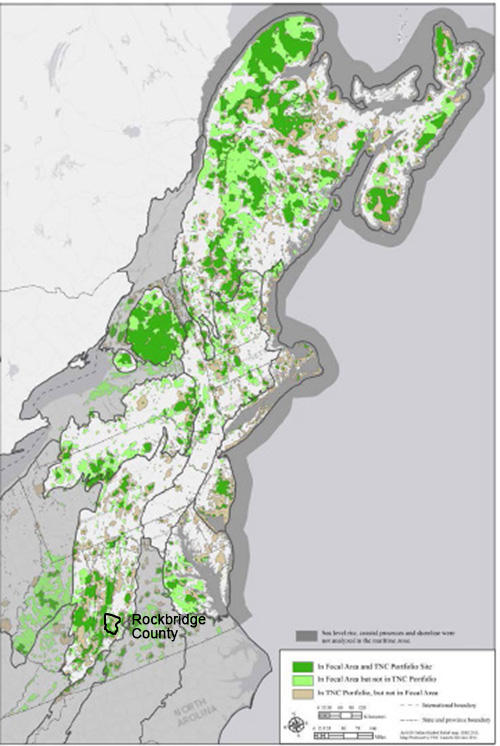
Natural Bridge is included in the Nature Conservancy’s estimate of areas (shown in dark green) in the Eastern United States with significant plant and animal diversity, or biodiversity. The Nature Conservancy uses these data to recommend greater conservation efforts in these regions. Click on map to enlarge. Map courtesy of The Nature Conservancy.
The Rockbridge area is already feeling the effects of climate change. In 2012, the United States Department of Agriculture redrew its Plant Hardiness Zone map, a standard that growers can use to determine what plants are likely to survive in a given region. The redrawn map reflects changes in average regional minimum temperatures.
Virginia, including Rockbridge County, is now in a warmer zone than in previous years. Humston says that while it is too early to measure precise changes in Rockbridge County, locals can expect warmer temperatures and greater variability in rainfall.
“We can expect our precipitation regime to change from being heavy in the spring to heavy in the summer,” he said.
Last summer’s unusual heavy rains might support his prediction. While climate scientists warn against attributing weather anomalies to global climate change, nearly all agree that humans should expect weather patterns to be less predictable in the future.
“The natural world constantly rearranges, but climate change is expected to accelerate natural dynamics, shifting seasonal temperature and precipitation patterns and altering disturbance cycles of fire, wind, drought and flood,” the Nature Conservancy study states.
As human development and climate change force the natural world to constantly rearrange itself, places like Natural Bridge will become key pockets of biodiversity, but only if they are protected from other human-induced damage. In a period of mass worldwide extinctions, local ecologies gain global importance, Humston said.
“If you lose local biodiversity you are also losing global biodiversity.”