
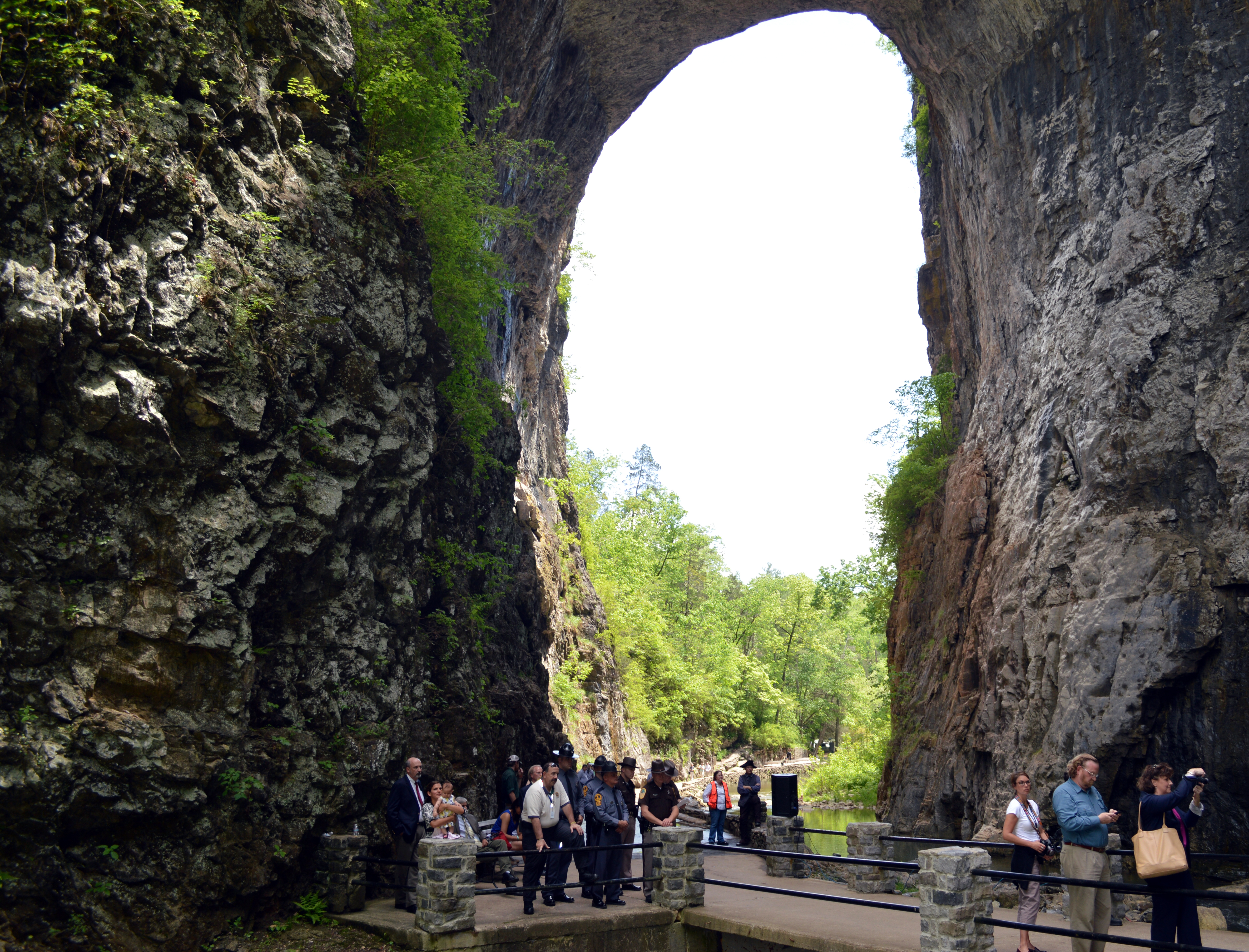
By Evelyn Rupert
The 1,500 acres surrounding Natural Bridge won’t become a Virginia state park for a few more years. But a state official tied closely to the project is already seeing a success story.
“I will predict that the Natural Bridge … will become one of the most visited state parks,” said Joe Elton, state parks director at the Virginia Department of Conservation and Recreation.
Elton said he thinks Natural Bridge’s location, cultural and natural significance and planned network of trails will help the proposed park surpass the Virginia Beach First Landing State Park’s annual $2 million in revenue and New River Trail State Park’s 1 million visitors.
Roanoke businessman Tom Clarke bought the property earlier this year, intending to give it to the state to use as a park by 2016. Clarke agrees with Elton on the area’s ability to draw visitors.
“The bridge has 150,000 visitors a year now, but I expect a million by the time it’s 10 years old as a state park,” he said.
The new owners and the state have a lot of work ahead of them first.
Clarke, president and CEO of Kissito Healthcare, a Roanoke-based nonprofit, created the Virginia Conservation Legacy Fund (VCLF) to buy the property from former owner Angelo Puglisi. When the sale was completed in early February, the foundation announced its goal to turn the land over to the state park system.
“Our hope is that, when we do pass it off to the Commonwealth, that that’s a fully-functioning state park,” Clarke said. “We’re hoping it’s going to be ready to go.”
But before that can happen, Clarke needs to pay off a $9 million loan that was part of the complex deal.
“We can’t donate this to the state when it’s encumbered with debt,” he said.
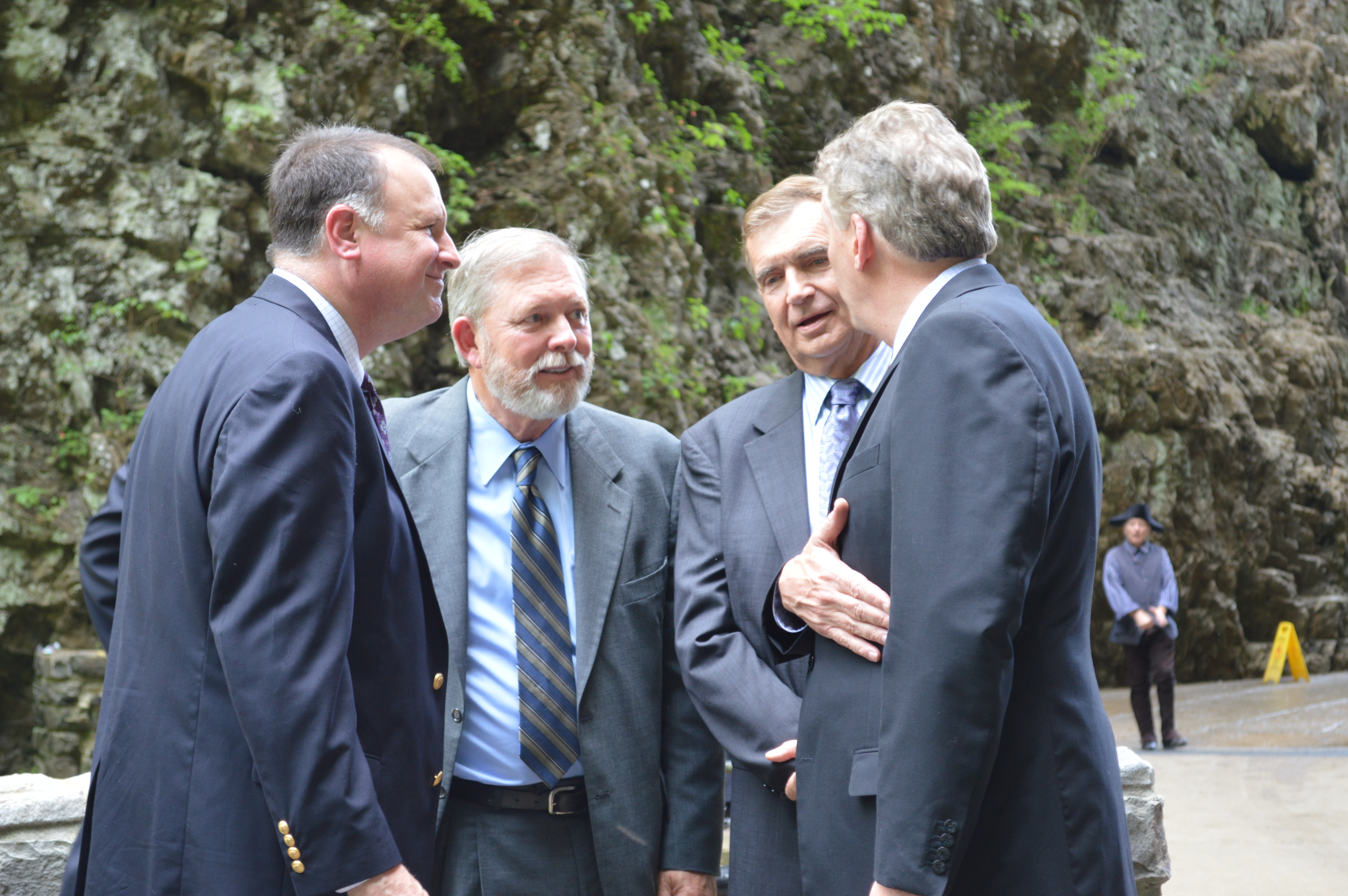
State Parks Director Joe Elton, center, greets state Sens. Creigh Deeds and Emmett Hanger and Gov. Terry McAuliffe, right, at Natural Bridge.
The state Department of Environmental Quality was able to lend the money to Clarke through a loan fund program, but Elton said the state didn’t have money to buy the property directly.
Elton said using just revenue from the Natural Bridge attractions and hotel, the VCLF should be able to repay the loan by the end of 2015. But he said with outside help that could be done sooner.
“Their hope is to raise private funds, conservation dollars, to help with that, and to find contributors big and small,” he said. “There’s even been discussions about school children giving pennies, nickels, and dimes to help with the effort.”
Jeff Waldon, a Kissito employee who is overseeing the changes at Natural Bridge, confirmed that VCLF was working with potential donors. But he said no donations have come in yet.
Even with the transfer a couple of years off, Clarke and Elton have already started laying the groundwork for the transition.
“We have an agreement in principle on that,” Elton said.
Waldon said the land would still end up with the state, even if the VCLF was to default on the loan.
“Either we pay off the loan and then we’re legally obligated to make the donation, or we don’t pay off the loan and the property reverts to the state,” he said. “So it’s going to be a state park one way or the other. The only question is when.”
Preparing for the transition
In the meantime, Clarke and his new management team are working to implement widespread changes at Natural Bridge.
The agreement calls for the state to own and manage the bridge itself, about 1,400 acres of mostly forested land, and the building that now houses the gift shop. The foundation will keep the hotel, caverns and the building that currently contains a wax museum.
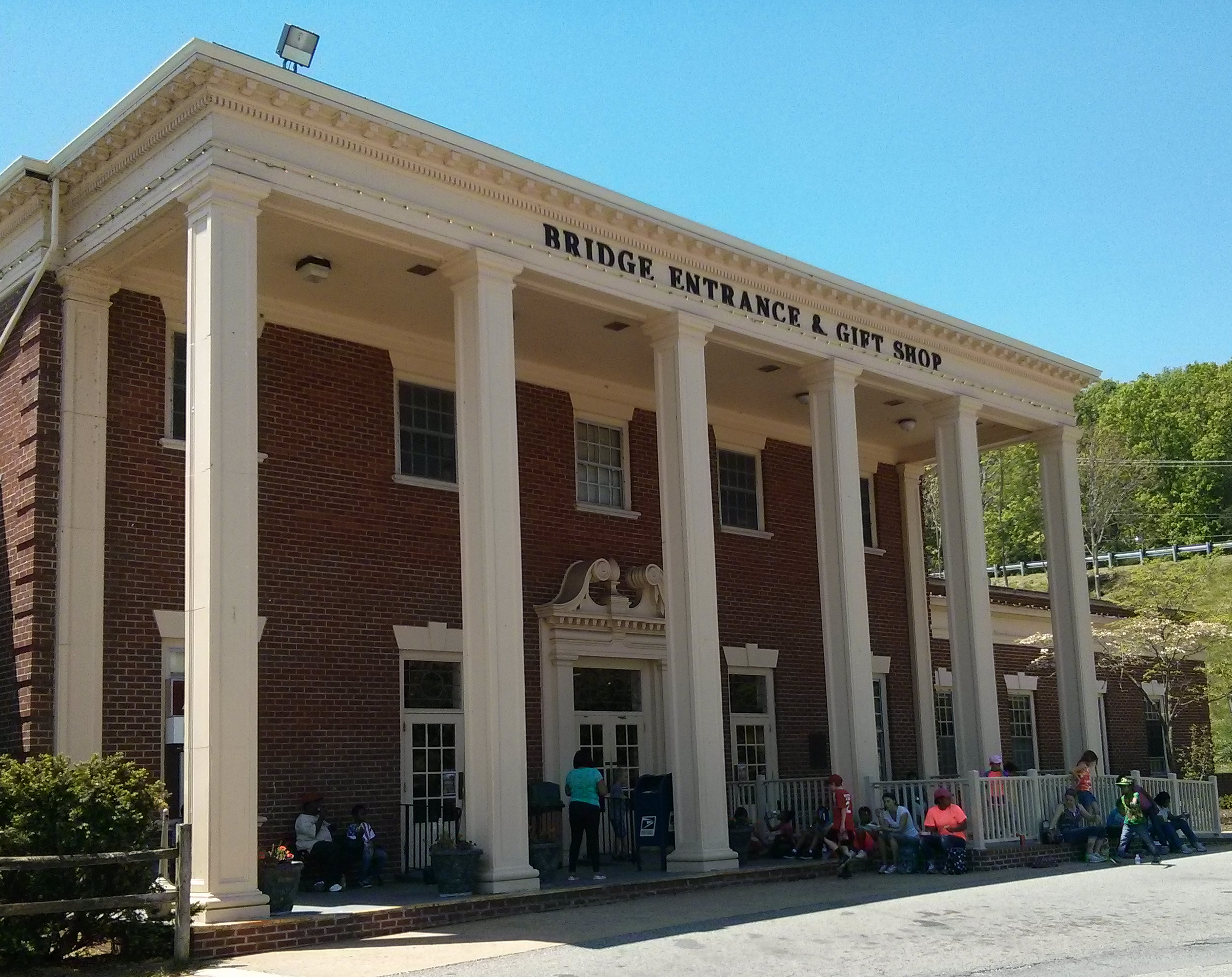
The 50,000-squre-foot gift shop building will be renovated and transferred to the state.
The gift shop building, now called the Rockbridge Center, is expected to become the park’s headquarters and new visitor center.
Waldon said the gift shop would still sell souvenirs, but the plans for the Rockbridge Center also include room for locally made food and crafts.
“Our hope is that over time, we’re going to be able to reorient the Rockbridge Center toward more of an artisan center than a gift shop,” he said. “The Rockbridge Center I think is going to be a really neat fixture of the campus here and of the community.”
Clarke stressed the importance of the “Made in Virginia” program.
“Why should we be selling things coming in 40-foot containers from Shanghai when you have great artisans all throughout Virginia that have reasonably priced products to sell?” he said. “We need to keep those refrigerator magnets and those coffee cups with your name on them. We will sell those, but the bulk of it’s going to be made in Virginia.”
Elton said he also hopes to see improvements to the land, including the addition of trails, before the state takes over.
“They know that the whole enterprise has been somewhat neglected over the last few years,” he said. “We’re working with them to make sure those improvements are consistent with the kinds of things we would want to do in a state park so that the transfer becomes as seamless as possible.”
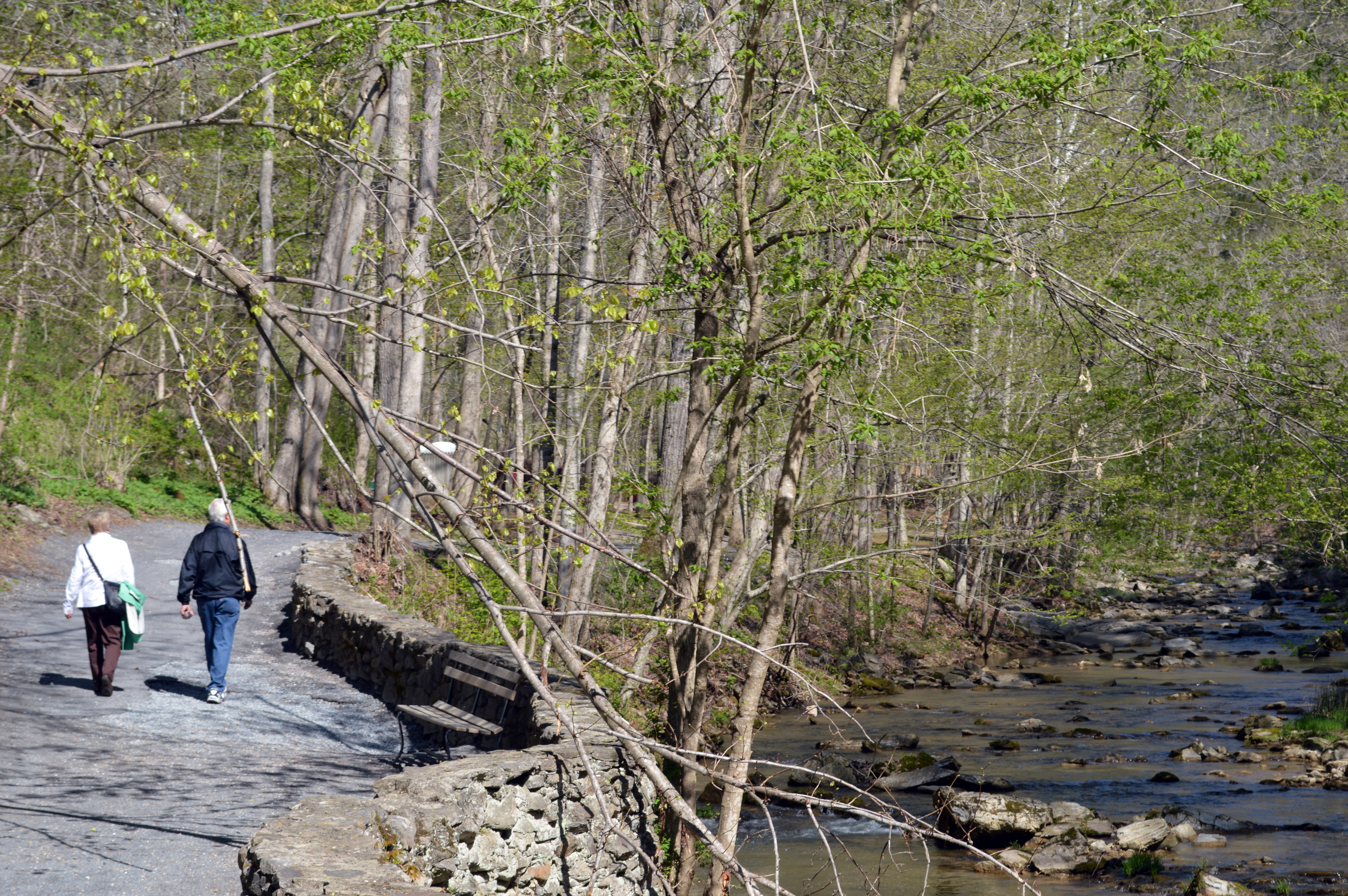
Cedar Creek trail, the primary walking path on the property, passes under Natural Bridge. About 20 additional miles of trails are planned.
Natural Bridge was formerly home to just one hiking trail, the one-mile Cedar Creek trail. Since February, the VCLF has already established the three-and-a-half-mile Monacan trail, but more trails will be needed. Powhatan State Park, for example, which opened in 2013 and is similar in size to the proposed park at Natural Bridge, contains six trails.
“We’re developing trails in the same format as they would,” Clarke said. “There’s so many different things that are all leading toward this becoming a state park pretty quickly.”
Waldon said that within a few weeks he hopes to have a mountain biking trail open on the north side of Route 130 near on the Buck Hill portion of the property.
A long-awaited change
The specific plans might be new, but Natural Bridge has been on the state’s radar for many years.
“There has been interest in the Natural Bridge becoming a state park for decades,” Elton said. “Something that the state parks director that served from ’61 to 1981 discussed with me before his passing, and I imagine that maybe even park directors before that had considered it.”
Puglisi had tried but failed several years ago to sell the property as one parcel. So when it was announced last year that the land would be split up and auctioned off as more than 30 parcels, local governments, interest groups and state and national organizations began an effort to preserve the area for public use.
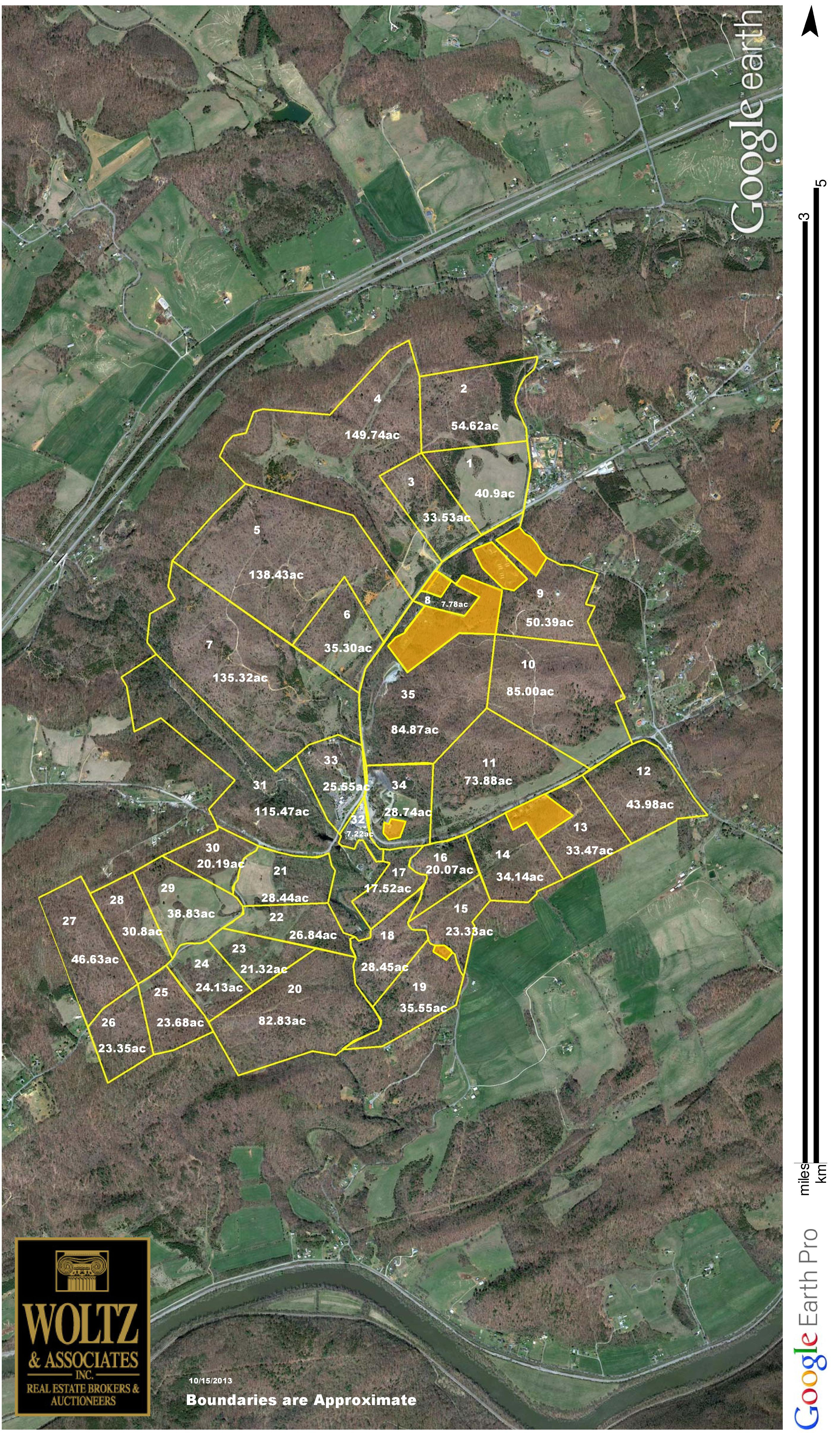
Map shows the 35 parcels former owner Angelo Puglisi initially planned to divide the property into at auction. Click on map to enlarge.
“I’m very impressed that the owner was willing to make sure that Natural Bridge didn’t go into a private development kind of thing and that it is going to be preserved for the citizens,” said Johnny Finch, president of the nonprofit Virginia Association for Parks.
In the summer of 2013, the city councils of Lexington and Buena Vista and the Rockbridge County Board of Supervisors passed resolutions to support the establishment of Natural Bridge as a state or national park.
The Rockbridge Area Conservation Council and the Valley Conservation Council, area nonprofits dedicated to preserving natural and cultural resources, came together with other interest groups to form the Friends of Natural Bridge to advocate for the preservation of the land.
Both the state and national park services performed surveys of the land to assess its value as a park.
The National Park Service’s preliminary survey concluded that “sale of the property could lead to additional development, degradation of viewsheds and natural resources, and loss of public access to the bridge and caverns” if the land was not purchased as a whole and protected.
State surveyors, with representatives from the broker firm Woltz and Associates, the county, Rockbridge Area Conservation Council and Valley Conservation Council, toured the land in late July. The survey team suggested that “strong consideration be given to acquiring portions of Natural Bridge to become a state park to ensure its protection and provide visitor access to such a unique geological and historical resource of the Commonwealth.”
The National Park Service survey, done at the request of U.S. Rep. Bob Goodlatte, R. – Roanoke, concluded that Congress should consider authorizing a full special resource study of Natural Bridge.
Elton said that turning Natural Bridge into a state park rather than a national park will allow the land to be protected sooner.
“If it’s going to happen in the short term, the state was going to be able to respond quicker than the federal government,” he said. “We have to be able to function more efficiently, more frugally, and so we do.”
Natural Bridge as a state park
According to the Department of Conservation and Recreation’s July survey, approximately 1,400 of the 1,531 acres is undeveloped, with about 80 percent of that land forested. The remaining acres are open rolling fields, creeks and ponds, and the Natural Bridge itself.
Cedar Creek flows through the property from Short Hill Mountain in Botetourt County, under the bridge itself, and empties into the James River one mile beyond the property borders.
While the Natural Bridge cavern attraction would remain under private ownership, there are a total of 11 caves on the property with more than 7,000 feet of surveyed passageways. Nine of the caves have not been investigated for plant and animal life.
There are records of several species of plants and animals of interest at Natural Bridge, including the eastern book trout in Cedar Creek, the rare plant species Addison’s leatherflower, and the unique Natural Bridge cave beetle.
The state park survey concludes that the land would accommodate camp sites and cabins, as well as an extensive trail system that could potentially provide a connection to the James River Heritage Trail and Upper James River Water Trail, with park programming at the river itself.
Expanding the state park system
The DCR currently manages 36 state parks. It is unclear how much the state will spend on additional renovations and improvements after the VCLF turns over the property. But the DCR estimates at least $500,000 in annual costs to operate the park, not including salaries.
The National Park Service survey estimated Natural Bridge’s annual operating costs as of last September to be about $400,000.
Elton said taking on another park should not be a problem financially for the state.
Lynn Crump, environmental programs planner at DCR, said there are currently six state parks waiting to be opened. She said at two of the locations, the state hasn’t acquired the minimum of 600 acres to open land as a park. There is insufficient funding for development and staff at the other four sites.
But she doesn’t expect the opening of Natural Bridge to be delayed.
“I’d be surprised if that happened. My expectation is that everything will be in place.”
“There is already infrastructure in place, both with facilities and staff,” she added in an email. “Also, since there is huge political and local support, there should be enough in place to make sure it happens.”
The conservation department’s entire budget has ranged from $123 million to $156 million since 2010. The fiscal year 2014 legislative appropriation for the state park system alone was about $35 million.
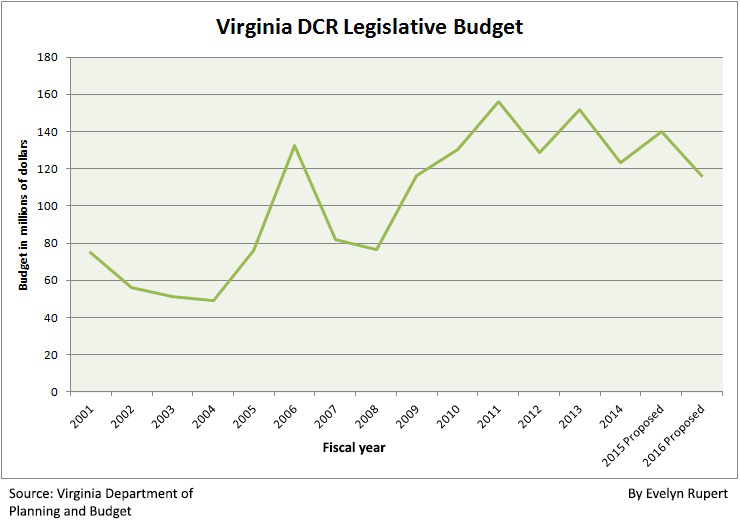
The commonwealth’s budget for conservation and recreation has fluctuated in recent years. But officials are confident that funding will be available to operate Natural Bridge as a state park. Click on graphic to enlarge.
The next state budget was still stalled in the General Assembly in late May, but Elton said Gov. Terry McAuliffe has not proposed any cuts to the parks budget.
“We’re hopeful that as the governor develops his budget for 2015, he recognizes the value of state parks in terms of the health and well-being of our citizens, the health and well-being of our environment, and the health and well-being of our economy, because our parks really are economic engines,” he said.
At a ceremony on May 12 celebrating Natural Bridge’s future as a state park, McAuliffe didn’t mention the state budget, but state Sen. Emmett Hanger, R.- Staunton, urged him to keep the Natural Bridge in mind.
“You and I are going to work together and have a budget before July 1,” he said. “Within that budget, tucked away nicely, is going to be a little lump of money to help with the transition of Natural Bridge to the state park system”
Next steps
Virginia law requires that the state create a master plan for each state park, a guide for the development, utilization and management of the park, and a summary of its natural, cultural and historic resources. There are three phases to a master plan, and legislators and the public must be given the opportunity to comment.
Crump said the first step is to inventory rare and endangered species, plant communities and other natural characteristics of the land. That inventory will include the context of the property, taking into consideration the adjacent properties and regional features.
“Then we start, kind of at the same time, we also put together a committee that’s usually made up of between 15 and 30 people that have some kind of vested interest in the park,” Crump said.
Elton said work on the master plan has already begun, and the conservation department will be seeking comment from local residents with ties to Natural Bridge.
“We’ll be enlisting…an advisory committee of local representatives and recreational users from different walks of life: hikers, bikers, horseback riders, that sort of thing,” he said.
Crump said Natural Bridge is unique because, normally, the state doesn’t start planning until it has taken control of at least 600 acres.
“In this case, someone else purchased the land and the negotiations started early on,” she said. “It’s a little bit different that way.”
The DCR will also have to work out the specifics of the private-public partnership on the property, with the caverns, hotel and wax museum building. There is also a waste treatment and water plant on the site, which will either stay with the foundation or be put under the control of Rockbridge County.
The state has no interest in the caverns, or in going into the hotel business, Elton said.
“The hotel and the caverns and some of the other commercial interests, the wax museum, have been looked upon as the proverbial ‘money pit,’” he said. “I think there was some prudence there on people’s parts to have the state absorb the parcels that made the most sense from a state park standpoint without taking on those commercial enterprises that we’re not as experienced at operating.”
Elton said sharing the land with private owners will take communication and planning, but shouldn’t be a problem.
“We’ll have to work together, we’ll have to be smart, we’ll have to figure out how to do those things,” he said. “But it’s not rocket science.”