
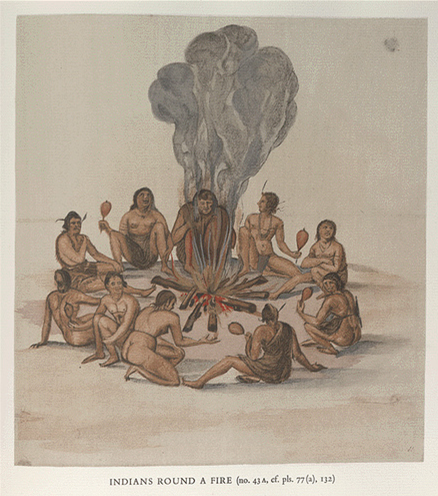
Late 16th century watercolor by John White of Virginia Indians.
By Janey Fugate
For more than two centuries, Natural Bridge has permeated the nation’s collective memory and remained a symbol of its natural and cultural heritage. And long before the birth of the nation, the bridge was part of a local Monacan Indian legend. They tell of the Creator forming the bridge before a band of Monacan hunters — divine intervention that allowed them to escape an enemy war party.
As the white man pushed Native American peoples farther west, the bridge came under the dominion of the British Crown. Its most illustrious owner, Thomas Jefferson, bought the bridge and surrounding acreage from King George III for 20 shillings in 1774 – the equivalent of $150 today – two years before the Declaration of Independence was written.
Jefferson would later be celebrated for the Louisiana Purchase and Manifest Destiny, the extension of the nation to all land west of the Mississippi River. But Jefferson never ventured farther west than Natural Bridge. For him, “that most sublime of nature’s works” was a symbolic gateway to the largely unexplored wilderness beyond the Mississippi.
The formation of that symbolic gateway puzzled its earliest non-Indian viewers, including Jefferson. Author and artist Isaac Weld wrote in 1798: “The two sides of the cataclysm were once united … but by what great agent they were separated, whether by fire or water – remains hidden.” Its origins remained a mystery until early-1900s scientists discovered it had formed from subterranean streams eroding the rock to form an enormous cave. Some 500 million years of erosion and weathering have done their work, leaving only the arched roof and sides intact today.
In 1818 four Washington College students scaled the geologic formation some said was not meant to be ascended by mere mortals. The endeavor, by William A. Caruthers and his compatriots, was the bridge’s first documented free climb. Caruthers wrote in a letter years later: “I have some reason to believe that I am the last surviving witness of that most adventurous exploit of climbing the Natural Bridge of Virginia … When we arrived at the bridge nearly all of us commenced climbing up the precipitous sides in order to immortalize our names.”
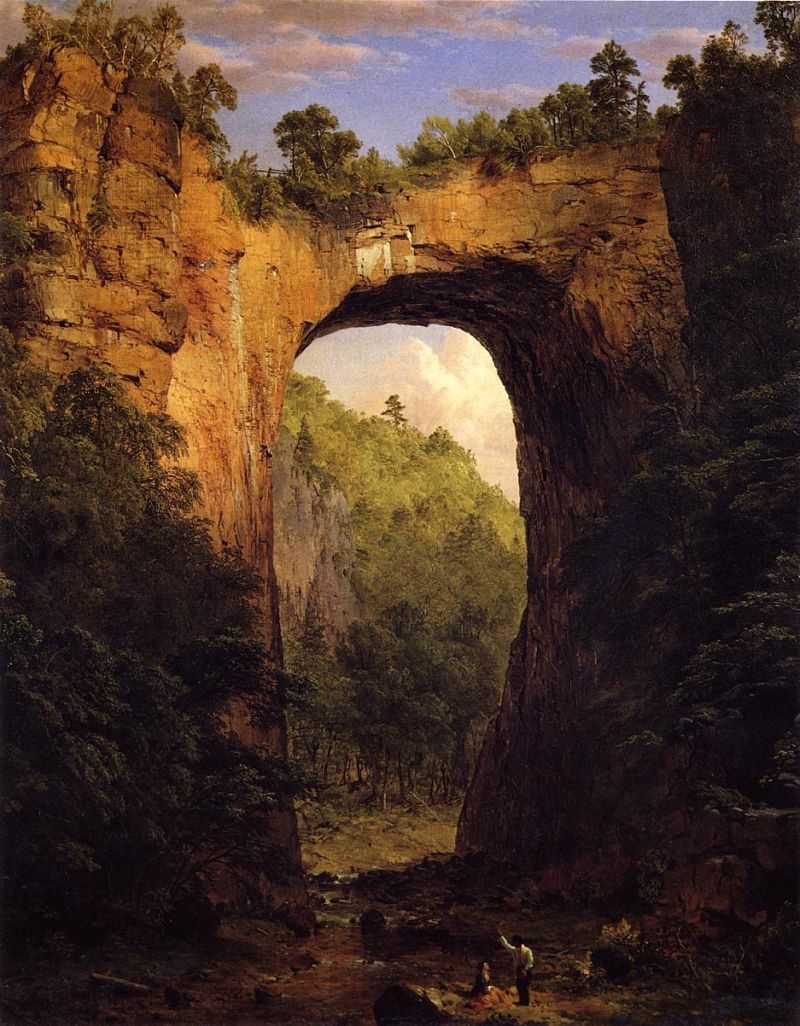
Frederick Edwin Church’s Natural Bridge, 1852
In the 1800s, the Romantic movement brought the bridge into the limelight. In 1833, Jefferson’s heirs sold it and the surrounding acreage to a new private owner, who built a hotel to accommodate the growing influx of curious tourists. The bridge’s rugged rocky face and spiritual allure made it an ideal site for artists with a fresh vision for painting the country’s landscapes.
One of the great painters of the American Hudson School of Art, Frederic Edwin Church, painted “The Natural Bridge, Virginia” in 1852. Herman Melville echoes this romantic portrayal of the bridge with his reference to it in “Moby Dick,” published in 1851. Describing the whale, he says, “But soon the fore part of him slowly rose from the water; for an instant his whole marbleized body formed a high arch, like Virginia’s Natural Bridge ….”
The bridge is also the site of a series of misadventures, tragedies and what some would call misjudgments. In 1936, a bus traveling over the bridge on Route 11 careened over the side, killing five people. In 1963, the hotel burned to the ground. A chunk of rock fell from the arch in 1999, killing a tourist.
In 1988, Washington D.C. real estate developer Angelo Puglisi bought the property. Over the years since it has acquired the trappings of a roadside tourist attraction, including a wax museum and a replica of Stonehenge made of styrofoam, aptly named Foamhenge.
Now the bridge’s ownership history is on the threshold of profound change. The 200-foot arch, in private hands since Jefferson, is destined to become a state park. In February Puglisi sold the bridge and surrounding acreage to Tom Clarke, owner of a Roanoke-based nonprofit, who will hand the property over to the state in less than two years. Until then, a unique combination of public and private management will ensure its ecosystem is protected from harmful development. Natural Bridge may now be undergoing the most transformative part of its evolution.
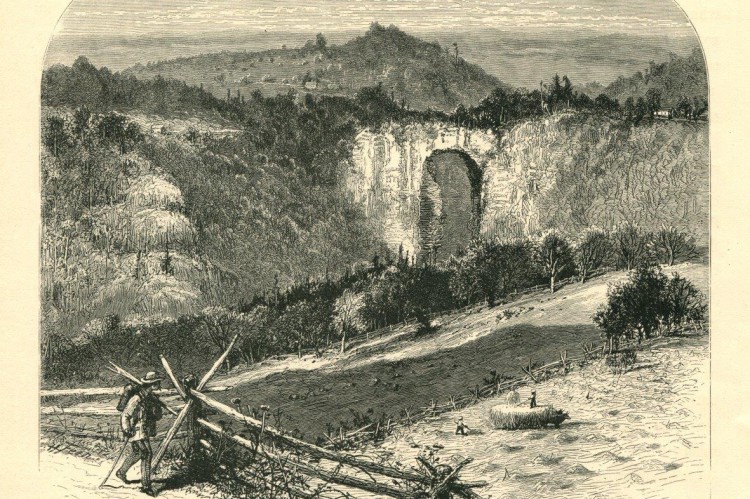
Top image: The Natural Bridge and its Surroundings, 1872 engraving